

Encryption is the process of converting readable plaintext into scrambled ciphertext using a complex cryptographic algorithm. The Advanced Encryption Standard (AES) is a symmetric-key algorithm used to encrypt and decrypt electronic data.
The method has become the global standard for protecting sensitive data from unauthorized access.
Below, we explain the benefits, modes, and most popular use cases of AES. So you can safeguard your personal information and private data.
Quick Facts:
The Advanced Encryption Standard (AES) is a cryptographic algorithm established by the National Institute of Standards and Technology (NIST) in 2001. In short, AES encrypts plaintext and decrypts ciphertext with the same key.
To be more specific, AES is a block cipher that divides electronic data into fixed groups. Each block contains 128 bits. An encryption engine generates a secret key based on credentials supplied by the user, such as a passcode. The initial key must originate from outside the block cipher. AES supports key lengths of 128, 192, or 256 bits.
Next, the engine runs the initial key through a deterministic algorithm, known as a key schedule. This process creates a series of round keys derived from previous keys in the sequence.
Then, the engine applies those round keys during encryption and decryption. It consumes one key per round to authenticate the user. A 128-bit key goes through 10 rounds. A 192-bit key faces 12 rounds. A 256-bit key must pass 14 rounds.
In theory, the nearly limitless number of permutations makes brute-force attacks infeasible. It would take the world’s fastest supercomputers quadrillions of years to crack the code and gain access to encrypted data.
Why Is Encryption Important?
Encryption is critical because it prevents valuable data from falling into the wrong hands. The World Economic Forum (WEF) reports that AI-driven cybercrime costs trillions of dollars per year. As a result, businesses of all sizes and people have a strong incentive to protect their files from theft.
Sensitive data that benefits from encryption includes:
- Personally identifiable information (PII)
- Login credentials
- Account numbers
- Financial statements
- Medical records
- Legal documents
- Intellectual property
- Trade secrets
- Employment history
- Classified materials
A data breach in any of these categories could lead to a financial shortfall, fines, and loss of trust.
AES Modes of Operation
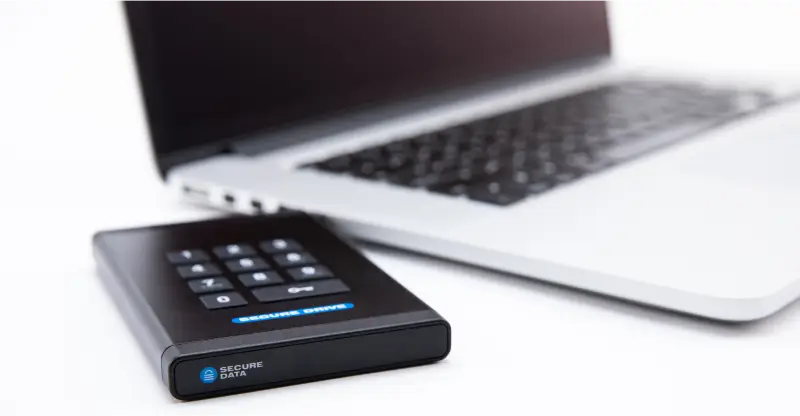
Because AES operates on 128-bit blocks, it has multiple techniques for processing data that exceeds that limit. These modes of operation help the algorithm split larger strings into usable blocks. Each mode serves a different purpose and tries to strike a balance between performance and security.
Electronic Codebook (ECB) and Cipher Block Chaining (CBC) are two of the original modes. ECB overcomes parallel processing problems by handling blocks separately, but identical plaintexts result in matching ciphertexts. CBC hides patterns by mixing sequential blocks of ciphertext and plaintext for file-level encryption.
Later, cryptographers developed Counter Mode (CTR) and Galois/Counter Mode (GCM). CTR treats the block cipher as a stream, encrypting a series of counter values to ensure no blocks are identical. The approach provides extremely fast encryption and decryption for high-speed networks and real-time messaging. GCM merges CTR mode with a tag to authenticate that the message has not been tampered with in transit. The method makes it the benchmark for secure web traffic.
However, these modes are not meant to encrypt data at rest.
XEX-based tweaked-codebook mode with ciphertext stealing (XTS) is the gold standard for encrypting storage.
Encrypting a storage device differs from scrambling a continuous stream of data. A storage device has a unique sector address that corresponds to an exact location on the physical media. Linking ciphertext with plaintext would require the hardware to read and decrypt the full disk to open a single file.
To solve the issue, XTS encrypts each block and sector of data with two independent keys. The localized technique means the hard disk drive (HDD) or solid-state drive (SSD) can process data without altering surrounding sectors. Therefore, it is an ideal mode for accessing and saving data at random.
XTS works by applying a tweak value to the plaintext before encryption. Then, it runs bits through the block cipher to mask data. Lastly, it performs another operation on the ciphertext after encryption. Once finished, even identical blocks of data on the device have unique ciphertexts.
Because of its design, XTS uses two AES keys of equal length. For example, 256-bit encryption requires users to supply a 512-bit key.
Put simply, XTS-AES is the most unbreakable encryption method for local storage.
Where Other Modes Fail for Encrypted Storage
Despite their strength, modes such as CTR and GCM were developed to encrypt data in transit. Using them as a full-disk encryption (FDE) method can leave user data vulnerable. Even with a secure key.
Here is a table that breaks down AES modes of operation and whether they are appropriate for encrypted storage:
ECB lacks the concealment features of other forms of encryption. Each 128-bit block uses the same ciphertext. Without context, it is possible to recognize patterns in repetitive blocks of data and decipher the encryption key.
CBC is susceptible to watermarking attacks. While CBC chains ciphertext and plaintext together to mask blocks, it often exposes the volume’s metadata. Bad actors can use partition tables and file headers or formats as a reference to decrypt data.
CTR and GCM are inadequate for a different reason. Both modes use a number, known as a nonce, to guarantee that a duplicate plaintext has a unique ciphertext. Reusing the nonce when the device overwrites a sector allows attackers to capture and compare the ciphertext.
Only XTS meets NIST’s strict standards for encrypted data storage on consumer devices.
XTS achieves its unrivaled security through a tweak function. The tweak function computes a value for each block in a sector using a pair of inputs. The first component is the sector address on the storage medium. It also includes a block offset to designate its location within the sector. The device encodes the tweak with a separate AES key, then performs a pair of operations to encrypt the data.
As a result, the ciphertext is always unique to a specific block, making it resistant to comparison attacks.
You can implement the AES engine in hardware and software encryption. However, hardware encryption offers better data protection and improved performance.
Software-based encryption uses the kernel driver on the central processing unit (CPU) of the computer. The design briefly reveals the key to the host system. Therefore, encryption software using XTS-AES is more exposed than a self-encrypting drive (SED). A determined attacker could try to image the PC’s memory to access the encrypted data. The method also comes with a clear performance trade-off.
On the other hand, hardware encryption uses a cryptographic processor. This specialized chip handles all operations on the storage device. It generates keys in a secure module and shields them from any other interface. The computer never sees the plaintext.
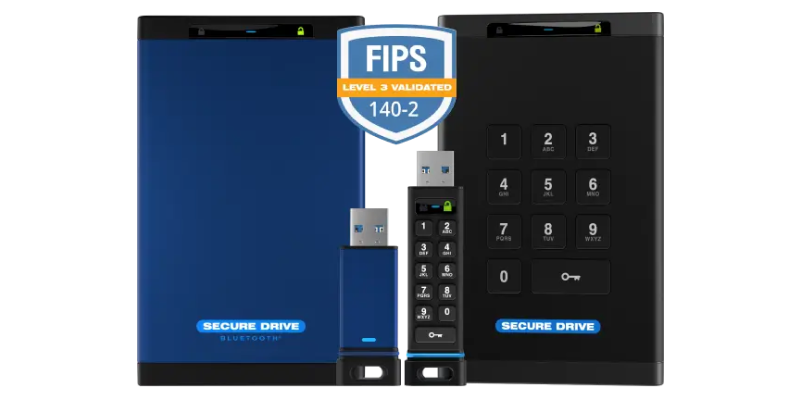
Our line of encrypted external drives and encrypted flash drives features an XTS-AES-256 engine and FIPS 140-2 Level 3 Validated hardware. This means:
- Your key never leaves the device.
- Your key is destroyed after 10 consecutive failed attempts to access data.
- Your device has epoxy-coated components to prevent physical tampering.
- You can instantly and securely erase the device by deleting the key.
- You are protected from cold boot attacks.
- You receive a license to on-board antivirus software for file transfers.
- You experience no performance loss.
Essentially, hardware encryption gives you complete control over your sensitive data. Software encryption does not.
When XTS-AES Encryption Is Essential
Regulators mandate XTS-AES encryption to protect confidential information in several industries.
Militaries and intelligence agencies across the globe demand secrecy. They rely on encrypted drives whether they are assigned to a domestic office or deployed overseas. Similarly, healthcare institutions in the U.S. must comply with HIPAA laws to protect patient records. Financial services companies face severe penalties for data breaches involving customer information. The GDPR grants extensive rights to consumers in Europe and compels entities to handle personal data carefully.
However, the benefits of AES encryption are not limited to governments and corporations. An encrypted external drive could bring peace of mind to a person looking for a local backup. Encryption gives them the confidence that their private files will remain private.
What XTS-AES Encryption Does Not Protect
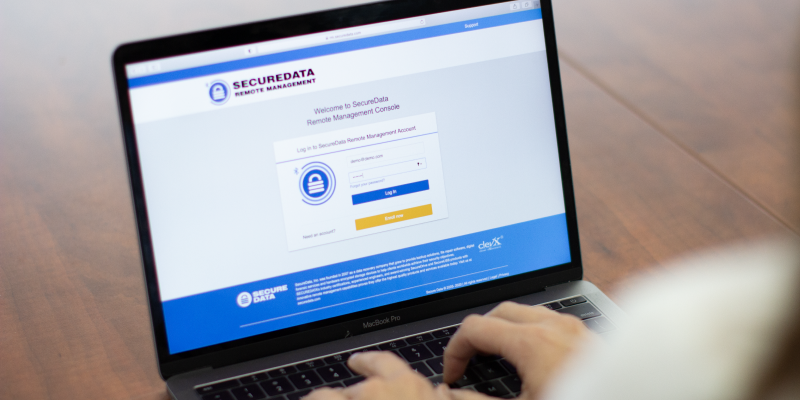
Ultimately, key management determines the strength of XTS-AES encryption for data at rest.
Weak passwords and lax access controls can still undermine even the most robust encryption engine. Follow best practices to maximize security. On occasion, NIST publishes recommendations for key management for those seeking to bolster all of their defenses.
In addition, XTS works in tandem with other AES modes to keep data safe in other states. For example, you can combine an XTS encrypted drive with AES-GCM to secure data in transit over networks.
SecureDrive®: XTS-AES Encryption for Priceless Data
SecureData provides data protection solutions for enterprise clients and home users alike.
Our SecureDrive® BT, SecureDrive® KP, and SecureDrive® DUO models deliver advanced encryption in a user-friendly package. The SecureDrive® SED is a self-encrypting drive for internal storage in workstations, desktops, and laptops.

Also, our SecureUSB® BT, SecureUSB® KP, and SecureDrive® DUO flash drives put the same protection in your fingertips.
Contact us to request a free evaluation of our award-winning products.
Frequently Asked Questions About XTS-AES Encryption
How does XTS-AES work?
XTS is a mode of operation for the AES block cipher. It is ideal for full-disk encryption. XTS tweaks the encryption process based on the physical location of a specific sector and block. The approach produces a unique ciphertext for each block of plaintext.
Is XTS-AES-256 secure?
Yes. XTS-AES-256 is incredibly secure for storing data at rest. The length and uniqueness of these keys make brute-force attacks infeasible. With proper key management, it totally prevents unauthorized access to sensitive files.
Has XTS-AES ever been cracked?
Not in the conventional sense. The compute required to crack the 256-bit key in an XTS-AES device does not currently exist. For context, the world’s fastest supercomputer performs about 1.8 quintillion operations per second as of 2026. That is 1,800,000,000,000,000,000 in numerical form. Yet, the supercomputer would still run out of time to test all combinations, given the hypothesized lifespan of the universe.





.png)
