

Have you ever lost an external drive with your most valuable files? Do you know what it would cost if you did?
The Los Angeles Times recently reported that film producer Simon Afram filed a $105 million lawsuit against Netflix and now a police report about the theft of an external drive.
Mr. Afram claims the streaming giant lost an external drive with a copy of Fortitude, an upcoming WWII spy thriller starring Nicolas Cage. Netflix disputes responsibility for the loss. Netflix said the production company delivered the unreleased film to its office on an unencrypted external drive, which doesn’t follow industry standards.
Of course, not everyone can relate to misplacing a Hollywood movie. However, many businesses and people use external hard drives or USB flash drives to transport sensitive data between home and work.
So, could the same thing ever happen to you?
What Unencrypted Drives Really Cost
In most cases, the hardware cost of a stolen unencrypted drive is only a fraction of the total loss.
Take Fortitude as an example. Losing a storage device doesn’t even register for major production companies or film studios. However, losing an unencrypted drive with a master copy of an unreleased movie that cost $45 million to make is a different story. A leak could greatly reduce the project's sale value to distributors. Not many parties are eager to pay tens of millions for a film that may appear online for free.
The same concept applies to everyday stakes.
Exposing a patient's protected health information (PHI) could trigger HIPAA penalties. Mishandling the personal data of EU citizens might result in massive GDPR fines for businesses. Failing to safeguard controlled unclassified information (CUI) under CMMC can lead to loss of federal contracts. Each outcome must consider the cost of breach notifications, litigation, and credit monitoring. It could also cause lasting reputational damage with customers, vendors, and potential buyers.
Individuals don’t escape the consequences either. Losing an unencrypted drive with your financial records raises the risk of identity theft.
Once an unencrypted drive goes missing, you lose control of your data.
How Encryption Turns a Stolen Drive Into a Brick
Encryption converts readable data (plaintext) into an unreadable format (ciphertext) using a complex algorithm and cryptographic key. The algorithm scrambles the data into gibberish. The key contains a string of bits that locks and unlocks the data.
Understanding exactly how encryption works involves a lot of advanced math and computer science.
Yet, the benefits of encryption are very simple. Without the key, no one can read data on the device, even if they have physical access to it. This design makes securing the encryption key critical. It is the only vulnerability.
There are hardware and software encryption methods. Hardware encryption is more secure because it automatically generates and stores the key in a specialized module. Software encryption can sometimes reveal the key to the operating system and compromise it to attackers.
If Fortitude was delivered on an encrypted external drive, the device loss would’ve been a non-story. A producer could’ve just brought Netflix a new copy the next day.
In addition, you can still close gaps around physical access.
Protection With SecureDrive® and Remote Management
Our award-winning encrypted external drives have robust security features to protect your data at all times. The SecureDrive® product line is FIPS 140-2 Level 3 Validated and Compliant. Having FIPS certification proves these external devices meet the strictest standards for data handling.
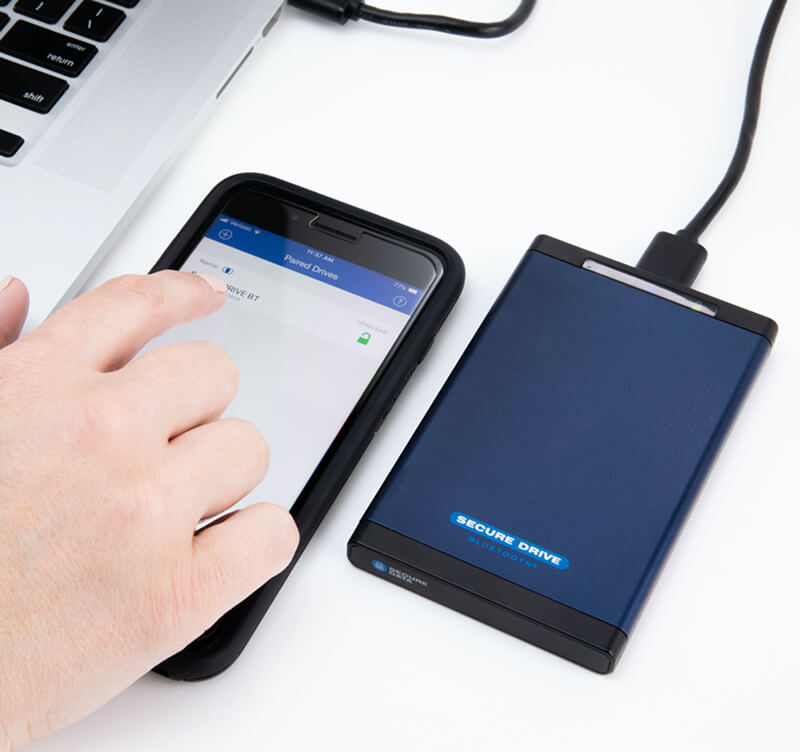
The SecureDrive® BT provides real-time XTS-AES-256 encryption at the hardware level. It replaces a passcode with biometric or wireless authentication, letting users use fingerprints, facial recognition, or a PIN on a smart device. SecureDrive® DUO combines those options with an onboard keypad. Both drives have auto-wipe for brute-force attacks and epoxy-coated components for tamper resistance.
You can buy them as external hard drives or SSDs. They range in capacities from 250 GB to 20 TB.
For businesses and home users with less data, our SecureUSB® encrypted flash drives put the same security in your hands.
Here’s a breakdown showing how unencrypted and encrypted drives compare:
Advantage of Remote Management
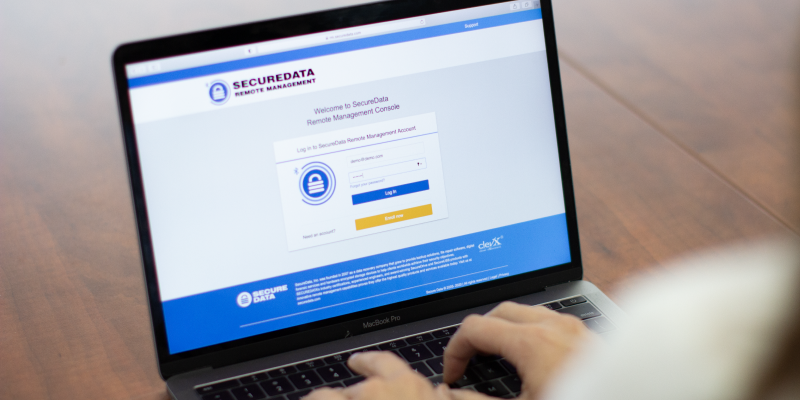
Our Remote Management console adds another layer of protection. The browser-based console lets IT teams manage a fleet of SecureDrive® and SecureUSB® products, including instantly erasing devices. It can turn access policies on and off across the account and fence usage by location or hours. The console also records geographic coordinates and timestamps for each attempt to authenticate a drive. These detailed logs provide a complete audit trail for portable storage.
These features give an admin the confidence to trust a courier with their data without fearing an incident.
Do You Need an Encrypted External Drive?
The math behind encryption is straightforward. A small upfront cost could prevent a large financial loss if important data on an unencrypted drive is exposed. According to IBM, the cost of a data breach in 2026 reached a record $4.99 million.
The checklist below outlines things to consider when deciding whether to use encrypted external drives:
If you checked even one box, then using an encrypted external drive is essential.
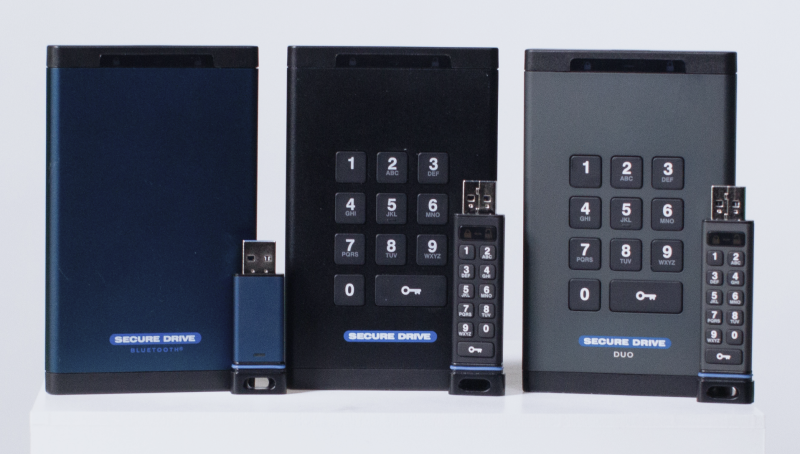
A SecureDrive® or SecureUSB® provides protection in each case. You get XTS-AES-256 hardware encryption out of the box, plus the option to add a license for our Remote Management console. A few hundred dollars could save your company millions.
Contact SecureData to request a free evaluation of our encrypted drives and protect your data today.
Frequently Asked Questions
What happens if I lose an encrypted drive?
Nothing. Whoever picks it up won’t be able to access any data without the encryption key. They only acquire a fancy paperweight.
Can encrypted drives be hacked?
No. An encrypted drive should have auto-wipe features to prevent brute-force attempts. Regardless, a 256-bit hardware encryption is impossible for modern computers to crack. For example, the most powerful computer in the world today would still be running operations trillions of years into the future.
Can a lost drive be wiped remotely?
Sometimes. It is not a standard feature, but some platforms let admins manage encrypted drives remotely for full control.





.png)
